| Предыдущая тема :: Следующая тема |
| Автор |
Сообщение |
kansalliskala 


Зарегистрирован: 19.07.2007
Сообщения: 5122
Откуда: Southern Finland countryside
Expire: 2016-12-30
|
 Отправлено: Вс Янв 03, 2010 11:22 am Заголовок сообщения: F16 rule extended? |
|
Отправлено: Вс Янв 03, 2010 11:22 am Заголовок сообщения: F16 rule extended? |
|
|
kansalliskala wrote:
I found this advice, but what next?
16 sunshine
11 weak, hazy sun (soft shadows)
8 cloudy bright (no shadows)
5.6 open shade or heavy forecast
what then:
4 -- ?
2.8 -- ?
2 -- ?
1.4 -- ?
_________________
MF: Kodak DCS SLR/c; Samsung NX10; OM-10; Canon T50
Zuiko 28/3.5, Distagon 35/2.8; Yashica ML 50/2;
Zuiko 50/1.4; S-M-C 120/2.8; Zuiko 135/3.5; 200/5;
Tamron AD1 135/2.8, Soligor 180/3.5; Tamron AD1 300/5.6
Tamron zooms: 01A, Z-210
Yashicaflex C; Київ 4 + Юпитер 8, 11; Polaroid 100; Olympus XA; Yashica T3
Museum stuff: Certo-Phot; Tele-Edixon 135; Polaris 90-190; Asahi Bellows; Ixus IIs
Projects: Agfa Isolette III (no shutter), Canon AE-1D (no sensor),
Nikon D80 (dead), The "Peace Camera"
AF: Canon, Tokina, Sigma Video: JVC GZ-MG275E |
|
| Наверх |
|
 |
magnet-2009


Зарегистрирован: 22.04.2009
Сообщения: 505
Откуда: Greece, Athens
|
Отправлено: Вс Янв 03, 2010 11:28 am Заголовок сообщения: Re: F16 rule extended? |
|
Отправлено: Вс Янв 03, 2010 11:28 am Заголовок сообщения: Re: F16 rule extended? |
|
|
magnet-2009 wrote:
| kansalliskala писал(а): |
4 -- ?
2.8 -- ?
2 -- ?
1.4 -- ? |
.......problems with cheap lens.... 
Anyway, this is a very good link...... http://www.fredparker.com/ultexp1.htm
_________________
My flickr___ My Wix___ RailPictures |
|
| Наверх |
|
|
marty
Зарегистрирован: 09.04.2009
Сообщения: 767
Откуда: Italy
|
Отправлено: Вс Янв 03, 2010 1:23 pm Заголовок сообщения: |
|
Отправлено: Вс Янв 03, 2010 1:23 pm Заголовок сообщения: |
|
|
marty wrote:
Hi, kansalliskala. I'm not sure if I'm understanding what you mean. The "Sunny 16 rule" is just a rule of thumb to determine a right enough exposure w/o a light meter. Basically it states that assuming the shutter speed being 1/film_speed the matching aperture to get a correct exposure will be the one corresponding to the lighting condition of the scene (as per the table you reported). Thus to use a different aperture you just need to adjust the shutter speed accordingly.
For a 100 ASA film you'll have a speed of 1/100" approximated to the nearest available of 1/125".
Assuming "sunshine" you'll have to use f16.
If you want to use let's say f8 you'll have to adjust the speed to 1/500".
Hope this helps, assuming was this you meant.
Cheers, Marty.
_________________
Canon FD
Bodies: AT-1, A-1, T-90
Lenses: nFD 20mm f2.8, 24 f2.8, 28 f2.8, 35 f2, FD 50 f1.8 S.C., 85 f1.8, 100 f2.8, 135 f2.8, 200 f4, 300 f4
|
|
| Наверх |
|
|
Arkku

Зарегистрирован: 28.02.2007
Сообщения: 1416
Откуда: Helsinki, Finland
|
Отправлено: Вс Янв 03, 2010 3:03 pm Заголовок сообщения: |
|
Отправлено: Вс Янв 03, 2010 3:03 pm Заголовок сообщения: |
|
|
Arkku wrote:
| marty писал(а): |
Assuming "sunshine" you'll have to use f16.
If you want to use let's say f8 you'll have to adjust the speed to 1/500".
Hope this helps, assuming was this you meant. |
He meant that the shutter speed remains constant and only the aperture changes, i.e. in “weak, hazy sun” open up to f/11 while keeping the exposure time at the reciprocal of ISO sensitivity. So, the question is, what kind of “typical” situations could the rule be extended to apart from those listed?
| kansalliskala писал(а): |
| 4 -- ? |
I'd say:
4 -- “Not so open shade” or open shade when the sunlight is weaker. |
|
| Наверх |
|
|
kansalliskala
Зарегистрирован: 19.07.2007
Сообщения: 5122
Откуда: Southern Finland countryside
Expire: 2016-12-30
|
Отправлено: Вс Янв 03, 2010 4:21 pm Заголовок сообщения: |
|
Отправлено: Вс Янв 03, 2010 4:21 pm Заголовок сообщения: |
|
|
kansalliskala wrote:
Thanks magnet-2009
then 2.8 would be
"Landscapes and skylines immediately after sunset. Crescent moon (long lens)."
and 2 would be
"Landscapes, city skylines 10 minutes after sunset. Neon lights, spotlighted subjects. "
asa 100 and 1/100
might be?
_________________
MF: Kodak DCS SLR/c; Samsung NX10; OM-10; Canon T50
Zuiko 28/3.5, Distagon 35/2.8; Yashica ML 50/2;
Zuiko 50/1.4; S-M-C 120/2.8; Zuiko 135/3.5; 200/5;
Tamron AD1 135/2.8, Soligor 180/3.5; Tamron AD1 300/5.6
Tamron zooms: 01A, Z-210
Yashicaflex C; Київ 4 + Юпитер 8, 11; Polaroid 100; Olympus XA; Yashica T3
Museum stuff: Certo-Phot; Tele-Edixon 135; Polaris 90-190; Asahi Bellows; Ixus IIs
Projects: Agfa Isolette III (no shutter), Canon AE-1D (no sensor),
Nikon D80 (dead), The "Peace Camera"
AF: Canon, Tokina, Sigma Video: JVC GZ-MG275E |
|
| Наверх |
|
|
magnet-2009
Зарегистрирован: 22.04.2009
Сообщения: 505
Откуда: Greece, Athens
|
Отправлено: Вс Янв 03, 2010 6:03 pm Заголовок сообщения: |
|
Отправлено: Вс Янв 03, 2010 6:03 pm Заголовок сообщения: |
|
|
magnet-2009 wrote:
Exactly, you know how to read tables[Exposure Factor Relationship Chart B] and relate the data on another one[Exposure Value Chart] .  
If your camera doesn't support 1/100, then use 1/125. 
_________________
My flickr___ My Wix___ RailPictures |
|
| Наверх |
|
|
cooltouch

Зарегистрирован: 15.01.2009
Сообщения: 9096
Откуда: Houston, Texas
|
Отправлено: Вс Янв 03, 2010 6:16 pm Заголовок сообщения: |
|
Отправлено: Вс Янв 03, 2010 6:16 pm Заголовок сообщения: |
|
|
cooltouch wrote:
I think maybe Magnet, you meant for the bold text to be links?
Several months ago, a member of another forum -- and I don't recall which one now -- put together a nice set of descriptions for suggested exposure values ranging from EV -6 to EV 17. And just to make it most useful, he also put together a chart showing the ratio of ISO/shutter speed/apertures based on these EVs.
He then uploaded the files to the forum. I could have sworn I had the files on my computer, but I cannot find them anywhere, so I did the next best thing, and scanned the pages I printed out. I printed the info on both sides of a single piece of paper, then folded it and put it inside a camera bag. So it's kind of wrinkled and dog-eared, but it is legible. I scanned at 200 dpi, which is adequate for text. Even so, the two files are large, about 900k apiece.
http://michaelmcbroom.com/lightsit1.jpg
http://michaelmcbroom.com/lightsit2.jpg
I have found this chart to be very useful because of the descriptions for lighting situations for all practical Exposure Values. In many cases, it obviates the need for an exposure meter.
I would recommend you do as I, if you find these charts useful, and print them out two-sided on a single page because its easier to stow in a camera bag.
If (when?) I can find the original files, I will repost links to them here.
_________________
Michael
My Gear List: http://michaelmcbroom.com/photo/gear.html
My Gallery: http://michaelmcbroom.com/gallery3/index.php/
My Flickr Page: https://www.flickr.com/photos/11308754@N08/albums
My Music: https://soundcloud.com/michaelmcbroom/albums
My Blog: http://michaelmcbroom.com/blogistan/ |
|
| Наверх |
|
|
magnet-2009
Зарегистрирован: 22.04.2009
Сообщения: 505
Откуда: Greece, Athens
|
Отправлено: Вс Янв 03, 2010 6:23 pm Заголовок сообщения: |
|
Отправлено: Вс Янв 03, 2010 6:23 pm Заголовок сообщения: |
|
|
magnet-2009 wrote:
cooltouch did you request permission to use these tables from Fred Parker?
The link was given above...... http://www.fredparker.com/ultexp1.htm
_________________
My flickr___ My Wix___ RailPictures |
|
| Наверх |
|
|
cooltouch
Зарегистрирован: 15.01.2009
Сообщения: 9096
Откуда: Houston, Texas
|
Отправлено: Вс Янв 03, 2010 6:33 pm Заголовок сообщения: |
|
Отправлено: Вс Янв 03, 2010 6:33 pm Заголовок сообщения: |
|
|
cooltouch wrote:
| magnet-2009 писал(а): |
| cooltouch did you request permission from Fred Parker? |
Well, I'll be darned. Ah, I see the link now. Missed it earlier. Instead I googled "Fred Parker" and "Exposure Values" and got this hit:
http://www.fredparker.com/ultexp1.htm#Light%20Intensity%20Chart
So the guy who posted what I downloaded just "borrowed" FP's charts. Oh well. FP does invite folks to d/l his charts, so I don't see the harm in posting. Thanks for the link, though. It's a valuable source of info.
_________________
Michael
My Gear List: http://michaelmcbroom.com/photo/gear.html
My Gallery: http://michaelmcbroom.com/gallery3/index.php/
My Flickr Page: https://www.flickr.com/photos/11308754@N08/albums
My Music: https://soundcloud.com/michaelmcbroom/albums
My Blog: http://michaelmcbroom.com/blogistan/ |
|
| Наверх |
|
|
martinsmith99

Зарегистрирован: 31.08.2008
Сообщения: 7029
Откуда: S Glos, UK
Expire: 2013-11-18
|
Отправлено: Вс Янв 03, 2010 8:21 pm Заголовок сообщения: |
|
Отправлено: Вс Янв 03, 2010 8:21 pm Заголовок сообщения: |
|
|
martinsmith99 wrote:
Well, being in the UK, Sunny 16 rarely applies!
Wet & windy 4 seems better.
_________________
Casual attendance these days |
|
| Наверх |
|
|
magnet-2009
Зарегистрирован: 22.04.2009
Сообщения: 505
Откуда: Greece, Athens
|
|
| Наверх |
|
|
kansalliskala
Зарегистрирован: 19.07.2007
Сообщения: 5122
Откуда: Southern Finland countryside
Expire: 2016-12-30
|
Отправлено: Пн Янв 04, 2010 7:33 am Заголовок сообщения: |
|
Отправлено: Пн Янв 04, 2010 7:33 am Заголовок сообщения: |
|
|
kansalliskala wrote:
Thank you very much for the links.
For a while I tried to understand what the mystical letters on the left meant, was it some memory code: "E", "V", "N" .. etc then I looked at the righmost column "S","H","U","T","T","E","R" 
_________________
MF: Kodak DCS SLR/c; Samsung NX10; OM-10; Canon T50
Zuiko 28/3.5, Distagon 35/2.8; Yashica ML 50/2;
Zuiko 50/1.4; S-M-C 120/2.8; Zuiko 135/3.5; 200/5;
Tamron AD1 135/2.8, Soligor 180/3.5; Tamron AD1 300/5.6
Tamron zooms: 01A, Z-210
Yashicaflex C; Київ 4 + Юпитер 8, 11; Polaroid 100; Olympus XA; Yashica T3
Museum stuff: Certo-Phot; Tele-Edixon 135; Polaris 90-190; Asahi Bellows; Ixus IIs
Projects: Agfa Isolette III (no shutter), Canon AE-1D (no sensor),
Nikon D80 (dead), The "Peace Camera"
AF: Canon, Tokina, Sigma Video: JVC GZ-MG275E |
|
| Наверх |
|
|
kansalliskala
Зарегистрирован: 19.07.2007
Сообщения: 5122
Откуда: Southern Finland countryside
Expire: 2016-12-30
|
Отправлено: Пн Янв 04, 2010 8:56 am Заголовок сообщения: |
|
Отправлено: Пн Янв 04, 2010 8:56 am Заголовок сообщения: |
|
|
kansalliskala wrote:
Do you think this would work?
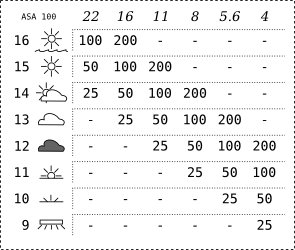
_________________
MF: Kodak DCS SLR/c; Samsung NX10; OM-10; Canon T50
Zuiko 28/3.5, Distagon 35/2.8; Yashica ML 50/2;
Zuiko 50/1.4; S-M-C 120/2.8; Zuiko 135/3.5; 200/5;
Tamron AD1 135/2.8, Soligor 180/3.5; Tamron AD1 300/5.6
Tamron zooms: 01A, Z-210
Yashicaflex C; Київ 4 + Юпитер 8, 11; Polaroid 100; Olympus XA; Yashica T3
Museum stuff: Certo-Phot; Tele-Edixon 135; Polaris 90-190; Asahi Bellows; Ixus IIs
Projects: Agfa Isolette III (no shutter), Canon AE-1D (no sensor),
Nikon D80 (dead), The "Peace Camera"
AF: Canon, Tokina, Sigma Video: JVC GZ-MG275E |
|
| Наверх |
|
|
Orio

Зарегистрирован: 24.02.2007
Сообщения: 29545
Откуда: West Emilia
Expire: 2012-12-04
|
Отправлено: Пн Янв 04, 2010 11:19 am Заголовок сообщения: |
|
Отправлено: Пн Янв 04, 2010 11:19 am Заголовок сообщения: |
|
|
Orio wrote:
in my own experience, when using colour negative film, F16 is for VERY bright sunlight, such as at the beach or on the snow, where the ambient reflections intensify the luminosity.
I follow this scheme and always found it correct for me:
F16 = very bright clear sky (at sea places, snowy mountains, sand deserts)
F11 = clear sky in normal places
F8 = sky veiled by very thin clouds
F5.6 = partly cloudy
F4 = full cloudy (overcast)
F2.8 = full cloudy (overcast) with dark and dense clouds
Plus you have these additional rules:
- shift of one stop the whole scheme in the half hour preceding the sunset
- shift of two stops the whole scheme in the 15 minutes after sundown.
BW negative, and slide film, are not to be used with the F16 scheme as they require more precise exposure than colour negative film.
_________________
Orio, Administrator
T*
NE CEDE MALIS AUDENTIOR ITO
Ferrania film is reborn! http://www.filmferrania.it/
Support the Ornano film chemicals company and help them survive!
http://forum.mflenses.com/ornano-chemical-products-t55525.html |
|
| Наверх |
|
|
kansalliskala
Зарегистрирован: 19.07.2007
Сообщения: 5122
Откуда: Southern Finland countryside
Expire: 2016-12-30
|
Отправлено: Пн Янв 04, 2010 3:51 pm Заголовок сообщения: |
|
Отправлено: Пн Янв 04, 2010 3:51 pm Заголовок сообщения: |
|
|
kansalliskala wrote:
Could be better.
Also 1 stop more in the spring and autumn 2 more in the winter on our latitudes. 
It is always surprising how inefficient is artificial lighting. A room that looks normal is pretty dark when you look at light meter.
_________________
MF: Kodak DCS SLR/c; Samsung NX10; OM-10; Canon T50
Zuiko 28/3.5, Distagon 35/2.8; Yashica ML 50/2;
Zuiko 50/1.4; S-M-C 120/2.8; Zuiko 135/3.5; 200/5;
Tamron AD1 135/2.8, Soligor 180/3.5; Tamron AD1 300/5.6
Tamron zooms: 01A, Z-210
Yashicaflex C; Київ 4 + Юпитер 8, 11; Polaroid 100; Olympus XA; Yashica T3
Museum stuff: Certo-Phot; Tele-Edixon 135; Polaris 90-190; Asahi Bellows; Ixus IIs
Projects: Agfa Isolette III (no shutter), Canon AE-1D (no sensor),
Nikon D80 (dead), The "Peace Camera"
AF: Canon, Tokina, Sigma Video: JVC GZ-MG275E |
|
| Наверх |
|
|
martinsmith99
Зарегистрирован: 31.08.2008
Сообщения: 7029
Откуда: S Glos, UK
Expire: 2013-11-18
|
Отправлено: Пн Янв 04, 2010 6:00 pm Заголовок сообщения: |
|
Отправлено: Пн Янв 04, 2010 6:00 pm Заголовок сообщения: |
|
|
martinsmith99 wrote:
I thought B&W negative film was very forgiving? My last roll of Tri-X with my hand held meter looked ok, and I was adding an extra stop if I wasn't sure.
_________________
Casual attendance these days |
|
| Наверх |
|
|
cooltouch
Зарегистрирован: 15.01.2009
Сообщения: 9096
Откуда: Houston, Texas
|
Отправлено: Пн Янв 04, 2010 6:27 pm Заголовок сообщения: |
|
Отправлено: Пн Янв 04, 2010 6:27 pm Заголовок сообщения: |
|
|
cooltouch wrote:
| kansalliskala писал(а): |
Do you think this would work?
|
It depends on what sort of film you're shooting. Your chart is about 1 stop underexposed from the Sunny F16 Rule. But this is correct exposure for slide film if your subject is predominantly white -- like a snow scene on a sunny day.
_________________
Michael
My Gear List: http://michaelmcbroom.com/photo/gear.html
My Gallery: http://michaelmcbroom.com/gallery3/index.php/
My Flickr Page: https://www.flickr.com/photos/11308754@N08/albums
My Music: https://soundcloud.com/michaelmcbroom/albums
My Blog: http://michaelmcbroom.com/blogistan/ |
|
| Наверх |
|
|
cooltouch
Зарегистрирован: 15.01.2009
Сообщения: 9096
Откуда: Houston, Texas
|
Отправлено: Пн Янв 04, 2010 6:31 pm Заголовок сообщения: |
|
Отправлено: Пн Янв 04, 2010 6:31 pm Заголовок сообщения: |
|
|
cooltouch wrote:
| martinsmith99 писал(а): |
| I thought B&W negative film was very forgiving? My last roll of Tri-X with my hand held meter looked ok, and I was adding an extra stop if I wasn't sure. |
That's my understanding too, although as is the case with any negative emulsion, it handles over exposure better than under exposure.
_________________
Michael
My Gear List: http://michaelmcbroom.com/photo/gear.html
My Gallery: http://michaelmcbroom.com/gallery3/index.php/
My Flickr Page: https://www.flickr.com/photos/11308754@N08/albums
My Music: https://soundcloud.com/michaelmcbroom/albums
My Blog: http://michaelmcbroom.com/blogistan/ |
|
| Наверх |
|
|
kansalliskala
Зарегистрирован: 19.07.2007
Сообщения: 5122
Откуда: Southern Finland countryside
Expire: 2016-12-30
|
Отправлено: Вт Янв 05, 2010 7:20 am Заголовок сообщения: |
|
Отправлено: Вт Янв 05, 2010 7:20 am Заголовок сообщения: |
|
|
kansalliskala wrote:
| cooltouch писал(а): |
| kansalliskala писал(а): |
Do you think this would work?
|
It depends on what sort of film you're shooting. Your chart is about 1 stop underexposed from the Sunny F16 Rule. But this is correct exposure for slide film if your subject is predominantly white -- like a snow scene on a sunny day. |
Sorry, I didn't explain the symbols. Sunny should be 2nd row. First row is Sunny with reflections (snow, sand, sea).
I'm not going to publish this or anything, just glue it on the hanldebar of my sports-bicycle next summer.
like this but with gears: http://www.flickr.com/photos/pcnotpc/2550152876/
http://forum.mflenses.com/what-are-your-plans-wishes-for-2010-t23652.html
_________________
MF: Kodak DCS SLR/c; Samsung NX10; OM-10; Canon T50
Zuiko 28/3.5, Distagon 35/2.8; Yashica ML 50/2;
Zuiko 50/1.4; S-M-C 120/2.8; Zuiko 135/3.5; 200/5;
Tamron AD1 135/2.8, Soligor 180/3.5; Tamron AD1 300/5.6
Tamron zooms: 01A, Z-210
Yashicaflex C; Київ 4 + Юпитер 8, 11; Polaroid 100; Olympus XA; Yashica T3
Museum stuff: Certo-Phot; Tele-Edixon 135; Polaris 90-190; Asahi Bellows; Ixus IIs
Projects: Agfa Isolette III (no shutter), Canon AE-1D (no sensor),
Nikon D80 (dead), The "Peace Camera"
AF: Canon, Tokina, Sigma Video: JVC GZ-MG275E |
|
| Наверх |
|
|
Nesster

Зарегистрирован: 24.04.2008
Сообщения: 5883
Откуда: NJ, USA
Expire: 2014-02-20
|
Отправлено: Вт Янв 05, 2010 11:39 am Заголовок сообщения: |
|
Отправлено: Вт Янв 05, 2010 11:39 am Заголовок сообщения: |
|
|
Nesster wrote:
I recall seeing exposure guides from Zeiss or Voigtlander or similar, from back in the day, that took into account the latitude and season...
I'd use your chart for ASA 160 color film in the summery months around New York, and in fact have done so with the Retinas.
--
The back of my Bessa 66 still has the original owner's crib sheet, which I transcribe here as a point of interest:
Verichrome Pan Index 100
Bt Sun f 16 1/100
Hazy Sun f 11 1/100
Cloudy Sun f 8 1/100
Open Sh f 5.6 1/100
A bog standard sunny 16 this, hardly worth taping onto the back of a camera
_________________
-Jussi
Camera photos
Print Photographica
|
|
| Наверх |
|
|
kansalliskala
Зарегистрирован: 19.07.2007
Сообщения: 5122
Откуда: Southern Finland countryside
Expire: 2016-12-30
|
Отправлено: Пт Янв 22, 2010 9:06 am Заголовок сообщения: |
|
Отправлено: Пт Янв 22, 2010 9:06 am Заголовок сообщения: |
|
|
kansalliskala wrote:
I'm thinking "really really simple rule" for pre-war folder use without meter. That could be a two-stop rule:
this is asa 100
very bright sunshine: 22 - 1/200
sunshine: 16 - 1/100
cloudy day: 11 - 1/50
really dark day: 8 - 1/25
evening, inside: open aperture more
and asa 400
sunshine: 22 - 1/200
cloudy day: 16 - 1/100
really dark day: 11 - 1/50
evening: 8 - 1/25
inside: open aperture more
I'm not sure but do you think this underexposes in the mid-section?
_________________
MF: Kodak DCS SLR/c; Samsung NX10; OM-10; Canon T50
Zuiko 28/3.5, Distagon 35/2.8; Yashica ML 50/2;
Zuiko 50/1.4; S-M-C 120/2.8; Zuiko 135/3.5; 200/5;
Tamron AD1 135/2.8, Soligor 180/3.5; Tamron AD1 300/5.6
Tamron zooms: 01A, Z-210
Yashicaflex C; Київ 4 + Юпитер 8, 11; Polaroid 100; Olympus XA; Yashica T3
Museum stuff: Certo-Phot; Tele-Edixon 135; Polaris 90-190; Asahi Bellows; Ixus IIs
Projects: Agfa Isolette III (no shutter), Canon AE-1D (no sensor),
Nikon D80 (dead), The "Peace Camera"
AF: Canon, Tokina, Sigma Video: JVC GZ-MG275E |
|
| Наверх |
|
|
|
|
 Русский
 Español
 中文
 Magyar
 Deutsch
 日本語
 Français