| Предыдущая тема :: Следующая тема |
| Автор |
Сообщение |
IANUS 


Зарегистрирован: 14.10.2008
Сообщения: 276
Откуда: Germany
|
 Отправлено: Пт Июн 25, 2010 7:32 am Заголовок сообщения: Light metering with bellows - How to? |
|
Отправлено: Пт Июн 25, 2010 7:32 am Заголовок сообщения: Light metering with bellows - How to? |
|
|
IANUS wrote:
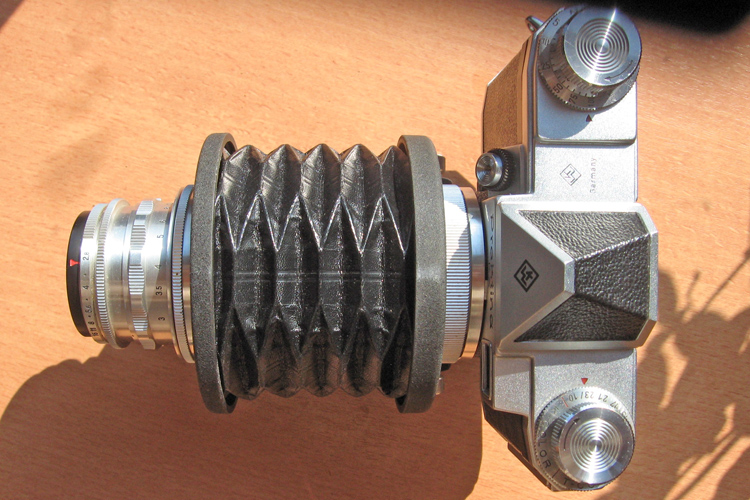
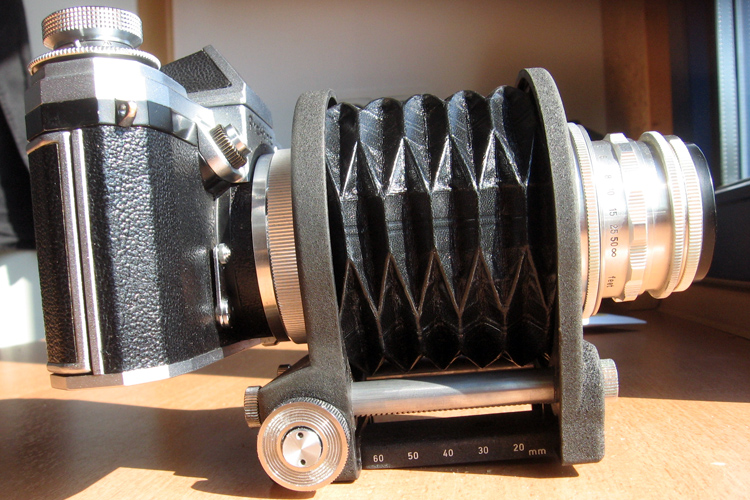
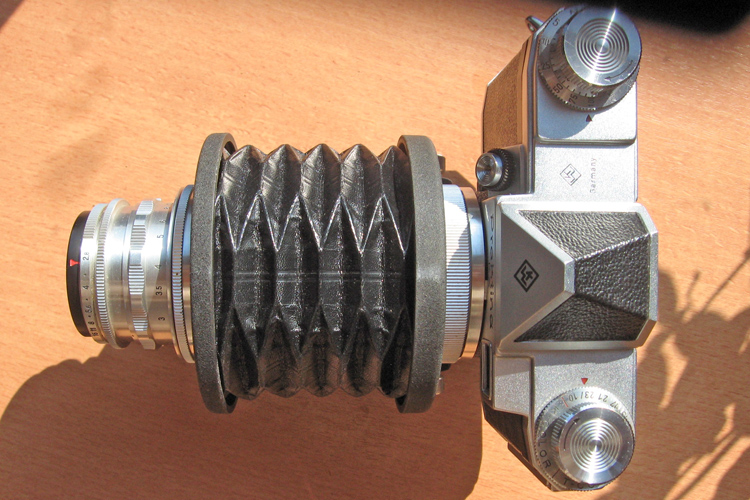
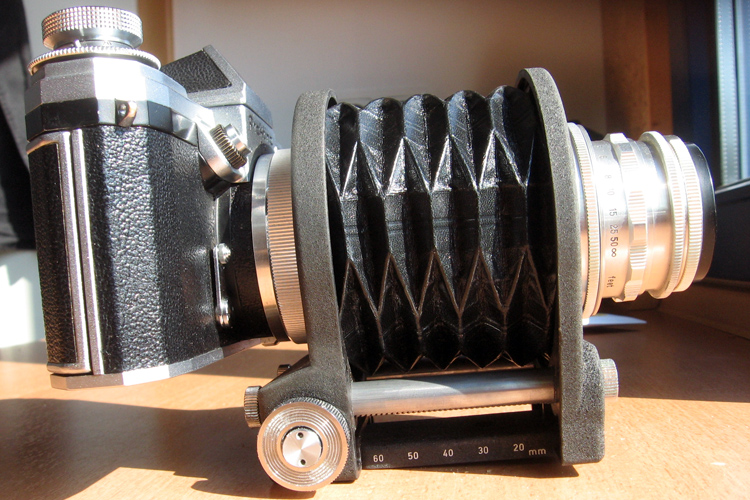
I've got a bellows unit for a Praktina camera and want to test it. Unfortunately I don't have a description for it and so I am questioning how I have to do the light metering. I never used a bellows for makro shots, only extension rings where I had to use factors for longer exposure. Obviously there is no ttl metering, which would be much easier.
Can anyone give me a description how to use the light meter with this set. I do hav a Gossen Profisix meter where I can dial in the factors for longer exposures but I have to somehow calculate them for myself.
Another question would be using a (manual) flash. How do I set up the flash.
 |
|
| Наверх |
|
 |
Excalibur


Зарегистрирован: 19.07.2009
Сообщения: 5018
Откуда: UK
Expire: 2014-04-21
|
Отправлено: Пт Июн 25, 2010 7:42 am Заголовок сообщения: |
|
Отправлено: Пт Июн 25, 2010 7:42 am Заголовок сообщения: |
|
|
Excalibur wrote:
As a film user this would be the time I wished for a DSLR, and I would think with that camera you would have to bracket your shots for exposure.
_________________
Canon A1, AV1, T70 & T90, EOS 300 and EOS300v, Chinon CE and CP-7M. Contax 139, Fuji STX-2, Konica Autoreflex TC, FS-1, FT-1, Minolta X-700, X-300, XD-11, SRT101b, Nikon EM, FM, F4, F90X, Olympus OM2, Pentax S3, Spotmatic, Pentax ME super, Praktica TL 5B, & BC1, , Ricoh KR10super, Yashica T5D, Bronica Etrs, Mamiya RB67 pro AND drum roll:- a Sony Nex 3
.........past gear Tele Rolleiflex and Rollei SL66.
Many lenses from good to excellent. |
|
| Наверх |
|
|
IANUS
Зарегистрирован: 14.10.2008
Сообщения: 276
Откуда: Germany
|
Отправлено: Пт Июн 25, 2010 7:46 am Заголовок сообщения: |
|
Отправлено: Пт Июн 25, 2010 7:46 am Заголовок сообщения: |
|
|
IANUS wrote:
| Цитата: |
As a film user this would be the time I wished for a DSLR, and I would think with that camera you would have to bracket your shots for exposure.
|
I know a DSLR would make most things easier but I may have to wait another 20-30 years to get a "classic" DSLR to play with  .
As a amateur-shooter I can allow me a whole film with bad shots and noone complains.
Bracketing is a good idea but this doesn't solve the problem from which center I am bracketing. |
|
| Наверх |
|
|
alex


Зарегистрирован: 18.04.2009
Сообщения: 561
Откуда: UK
|
Отправлено: Пт Июн 25, 2010 9:17 am Заголовок сообщения: |
|
Отправлено: Пт Июн 25, 2010 9:17 am Заголовок сообщения: |
|
|
alex wrote:
If you can use a scientific calculator, a very rough measure of the exposure compensation can be calculated this way :
Measure the extension of the bellows from the camera lens mount to where the bellows meet the lens.
Calculate log10 ( (extension + lens focal length) / lens focal length )
Divide result by 0.3. [This is to convert a log10 calculation to a log2 calculation in case your calculator doesn't have a log2 key.]
That's the exposure compensation in stops.
Example : bellows extension 30mm, lens focal length 50mm
log10 ( 80 / 50 ) = 0.204
0.204 / 0.3 = 0.68 or 2/3rds of a stop.
There are other factors that come in to play, such as the focus distance, because this calculation assumed the lens is focussed at infinity, but it's a starting point. You could probably draw up a little table for different bellows extension lengths and attached lens focal lengths.
_________________
Alex |
|
| Наверх |
|
|
IANUS
Зарегистрирован: 14.10.2008
Сообщения: 276
Откуда: Germany
|
Отправлено: Пт Июн 25, 2010 12:33 pm Заголовок сообщения: |
|
Отправлено: Пт Июн 25, 2010 12:33 pm Заголовок сообщения: |
|
|
IANUS wrote:
thanks alex, I will try this. |
|
| Наверх |
|
|
Farside

Зарегистрирован: 01.09.2007
Сообщения: 6579
Откуда: Ireland
Expire: 2013-12-27
|
Отправлено: Сб Июн 26, 2010 12:02 am Заголовок сообщения: |
|
Отправлено: Сб Июн 26, 2010 12:02 am Заголовок сообщения: |
|
|
Farside wrote:
Rough rule of thumb based on the inverse square law: if the lens is twice the distance from the film than it is normally, you get a quarter of the light intensity on the film, so you'd have to open up two stops or two shutter speeds.
Extrapolate from there, using your bellows distance as it actually is, when you're set up on the subject, compared to normal lens to film plane distance.
This gives you a starting point, but the relationship might not be utterly reliable as you go out further - trial and error to a certain extent thereafter.
Here's a useful device http://www.salzgeber.at/disc/
_________________
Dave - Moderator
Camera Fiend and Biograph Operator
If I wanted soot and whitewash I'd be a chimney sweep and house painter.
The Lenses of Farside (click)
BUY FRESH FOMAPAN TO HELP KEEP THE FACTORY ALIVE ---
Foma Campaign topic -
http://forum.mflenses.com/foma-campaign-t55443.html
FOMAPAN on forum -
http://www.mflenses.com/fs.php?sw=Fomapan
Webshop Norway
http://www.fomafoto.com/
Webshop Czech
https://fomaobchod.cz/inshop/scripts/shop.aspx?action=DoChangeLanguage&LangID=4 |
|
| Наверх |
|
|
RioRico

Зарегистрирован: 12.03.2010
Сообщения: 1120
Откуда: California or Guatemala or somewhere
|
Отправлено: Сб Дек 11, 2010 5:10 pm Заголовок сообщения: |
|
Отправлено: Сб Дек 11, 2010 5:10 pm Заголовок сообщения: |
|
|
RioRico wrote:
Another way to calculate this, starting with magnification:
MAG = (TE-FL) / FL where TE is total extension and FL is focal length
So with a 50mm camera lens on 100mm of extension, TE= 150mm. Magnification is (150-50)/50 or 2X. Now we can calculate f-stops:
EA = NA * (MAG+1) where EA is effective aperture and NA is nominal aperture
So with the previous setup and the lens set to f/11 (the nominal aperture), the effective aperture is 11 * (2+1) or f/33. You need to adjust exposure by 3 f-stops. More simply, exposure adjustment is (MAG+1) f-stops.
_________________
Too many film+digi cams+lenses, oh my -- Pentax K20D, K-1000, M42s, more
The simple truth is this: There are no neutral photographs. --F-Stop Fitzgerald |
|
| Наверх |
|
|
|
|
|
Вы не можете создавать новые темы в этом форуме
Вы не можете отвечать в темах этого форума
Вы не можете редактировать свои сообщения в этом форуме
Вы не можете удалять свои сообщения в этом форуме
Вы не можете голосовать в опросах этого форума
|
 Русский
 Español
 中文
 Magyar
 Deutsch
 日本語
 Français