| Предыдущая тема :: Следующая тема |
| Автор |
Сообщение |
fuzzywuzzy 

Зарегистрирован: 18.12.2010
Сообщения: 1258
Откуда: Down East, Canada, eh?
Expire: 2013-11-30
|
 Отправлено: Пт Мар 18, 2011 1:33 am Заголовок сообщения: Nikkor Q 200mm f4, a little fungus, and sample pics |
|
Отправлено: Пт Мар 18, 2011 1:33 am Заголовок сообщения: Nikkor Q 200mm f4, a little fungus, and sample pics |
|
|
fuzzywuzzy wrote:
I bought this lens for $40 a few weeks ago from a gentleman on Kijiji.
When I got home I discovered some pretty serious fungus on the rear element, that will teach me to inspect more carefully before I hand over cash... In my defence it's hard to see the fungus unless you shine a light thru the rear element, and then it's pretty ugly.

My Nikon-EF adapter arrived in the mail this week, and I was excited to finally take some shots and see what I'd bought. The lens is heavy and acts like a 320mm on my 1.6x crop Canon Rebel XS, it's going to take practice shooting this handheld.
tripod shots:
1) One of my son's Transformers, probably f4 or f5.6

2) 100% crop of a magazine page at f4

3) 100% crop of a magazine page at f8, don't see much difference to be honest.

4) My daughter swinging, I prefocused and just took a bunch of shots hoping to get some in frame, in focus and with a nice expression. Yay digital! Probably f5.6

5) Handheld, probably f5.6

Post processing limited to crops and resizes. I'm overjoyed at the IQ considering the fungus.
I've become comfortable using live view on a tripod, it seems to work very well. I'm not so happy about it handheld, it seems more stable bracing the camera against my face and my elbows against my body. The nice thing about a sunny day with snow on the ground is that you've got a lot of light to work with and can get ridiculous shutter speeds 
I love the bang for buck with old lenses, and I'm getting used to manual focusing, but I gotta say I miss having the aperture recorded in the EXIF data. |
|
| Наверх |
|
 |
gaeger
Зарегистрирован: 16.01.2010
Сообщения: 794
Откуда: Brier, Wash.
Expire: 2026-01-06
|
Отправлено: Пт Мар 18, 2011 2:56 am Заголовок сообщения: |
|
Отправлено: Пт Мар 18, 2011 2:56 am Заголовок сообщения: |
|
|
gaeger wrote:
Those are pretty good images considering the fungus!
_________________
Nikon: Bunch of stuff
Minolta: Bunch of stuff
Petri & Zenobia: Less stuff
Instagram | the.klahini |
|
| Наверх |
|
|
Orio
Зарегистрирован: 24.02.2007
Сообщения: 29545
Откуда: West Emilia
Expire: 2012-12-04
|
Отправлено: Пт Мар 18, 2011 2:06 pm Заголовок сообщения: |
|
Отправлено: Пт Мар 18, 2011 2:06 pm Заголовок сообщения: |
|
|
Orio wrote:
Unfortunately the fungus lower the contrast and produces hazy look. I think the lens would be worth a cleaning.
_________________
Orio, Administrator
T*
NE CEDE MALIS AUDENTIOR ITO
Ferrania film is reborn! http://www.filmferrania.it/
Support the Ornano film chemicals company and help them survive!
http://forum.mflenses.com/ornano-chemical-products-t55525.html |
|
| Наверх |
|
|
fuzzywuzzy
Зарегистрирован: 18.12.2010
Сообщения: 1258
Откуда: Down East, Canada, eh?
Expire: 2013-11-30
|
Отправлено: Пт Мар 18, 2011 3:10 pm Заголовок сообщения: |
|
Отправлено: Пт Мар 18, 2011 3:10 pm Заголовок сообщения: |
|
|
fuzzywuzzy wrote:
| Orio писал(а): |
| Unfortunately the fungus lower the contrast and produces hazy look. I think the lens would be worth a cleaning. |
No doubt.
I've done some googling and I don't see an obvious way to get at the rear element. I've never disassembled a lens and I'm a little nervous of just jumping in and seeing how it's put together. And of course I wanted to see how it performed before I even consider getting out the tools.
I'll try a bit of post-processing, for contrast at least.
But really, coming from the point'n'shoot world I guess I have low standards The pics I'm getting even with fungus, are much clearer then what I'm used to. Also I'm honestly not sure how much opportunity I'll have to use a 200mm prime.
I do think I'll put in a birdfeeder once the weather warms up and the birds start to come back, hopefully that'll encourage me to get some use out of the lens. |
|
| Наверх |
|
|
Attila

Зарегистрирован: 24.02.2007
Сообщения: 58005
Expire: 2025-11-18
|
Отправлено: Пт Мар 18, 2011 6:11 pm Заголовок сообщения: |
|
Отправлено: Пт Мар 18, 2011 6:11 pm Заголовок сообщения: |
|
|
Attila wrote:
This is a very good lens, worth to clean it and enjoy it's nice color rendering. Lens is not difficult easy to take out rare element and clean it. |
|
| Наверх |
|
|
D1N0

Зарегистрирован: 07.08.2012
Сообщения: 2726
|
Отправлено: Чт Мар 03, 2022 5:13 pm Заголовок сообщения: |
|
Отправлено: Чт Мар 03, 2022 5:13 pm Заголовок сообщения: |
|
|
D1N0 wrote:
I had bought one a while a ago with the intention to convert it to K-mount but just ended up breaking the aperture spring so I can't stop it down anymore. Luckily it is already very sharp wide open. (Old Nikon F fits K-mount mounted upside down)
This has been sitting a a shelf for over 2,5 years with the rear opened up and I of course lost half the screws.
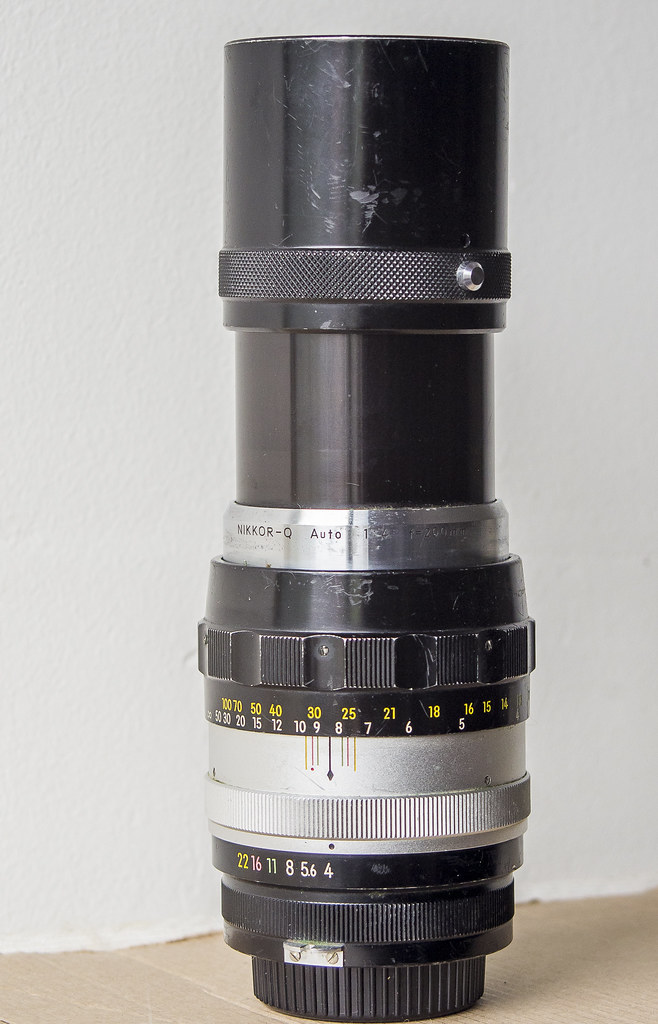 Nikkor-Q auto 1:4 200mm by The lens profile, on Flickr
Test shots today:
 Thornkeh by The lens profile, on Flickr
 Fencekeh by The lens profile, on Flickr
Sharpened even more (it is already very sharp):
 Sharp wide open by The lens profile, on Flickr
_________________
pentaxian |
|
| Наверх |
|
|
Doc Sharptail

Зарегистрирован: 23.11.2020
Сообщения: 1504
Откуда: Winnipeg Canada
|
Отправлено: Чт Мар 03, 2022 7:11 pm Заголовок сообщения: |
|
Отправлено: Чт Мар 03, 2022 7:11 pm Заголовок сообщения: |
|
|
Doc Sharptail wrote:
A few sample shots from a 200mm f4 Q.C. Nikkor already posted on the digital gallery forum here.


The blueberries were taken at f8, and the water line at f4.
-D.S.
_________________
D-810, F2, FTN, FT-3 in Black
35mm f2 O.C. nikkor
50 f2 H nikkor, 50 f2 H.C. nikkor, 50 f 1.4 AI-s, 135 f3.5 Q,
50 f2 K nikkor 2x, 28-85mm f3.5-4.5 A/I-s, 35-105 3.5-4.5 A/I-s, 200mm f4 Micro A/I, partial list.
"Ain't no half-way" -S.R.V.
"Oh Yeah... Alright" -Paul Simon |
|
| Наверх |
|
|
stevemark
Зарегистрирован: 29.04.2011
Сообщения: 5511
Откуда: Switzerland
|
Отправлено: Пт Мар 04, 2022 6:14 pm Заголовок сообщения: |
|
Отправлено: Пт Мар 04, 2022 6:14 pm Заголовок сообщения: |
|
|
stevemark wrote:
| D1N0 писал(а): |
I had bought one a while a ago with the intention to convert it to K-mount but just ended up breaking the aperture spring so I can't stop it down anymore. Luckily it is already very sharp wide open. (Old Nikon F fits K-mount mounted upside down)
This has been sitting a a shelf for over 2,5 years with the rear opened up and I of course lost half the screws.
Nikkor-Q auto 1:4 200mm by The lens profile, on Flickr
|
That seems to the first computation! The second, improved computation basically has the same lens section, but different glass (see https://imaging.nikon.com/history/story/0048/index.htm). Its focusing ring is much larger.
S
_________________
www.artaphot.ch |
|
| Наверх |
|
|
Doc Sharptail
Зарегистрирован: 23.11.2020
Сообщения: 1504
Откуда: Winnipeg Canada
|
Отправлено: Пт Мар 04, 2022 6:24 pm Заголовок сообщения: |
|
Отправлено: Пт Мар 04, 2022 6:24 pm Заголовок сообщения: |
|
|
Doc Sharptail wrote:
[quote="stevemark"]
The modified lens discussed in this text was never commercially available.
It was a design experiment by nippon kogaku staff.
The release of the Q.C. version was a similar, but not identical lens.
There were non-optical modifications that the Q.C. received, and not the lens in the text.
The Q.C. received a bit of an upgrade to the aperture system as well, and it's own designated coatings.
The Q.C. lens was indeed a descendant of this design work.
-D.S.
_________________
D-810, F2, FTN, FT-3 in Black
35mm f2 O.C. nikkor
50 f2 H nikkor, 50 f2 H.C. nikkor, 50 f 1.4 AI-s, 135 f3.5 Q,
50 f2 K nikkor 2x, 28-85mm f3.5-4.5 A/I-s, 35-105 3.5-4.5 A/I-s, 200mm f4 Micro A/I, partial list.
"Ain't no half-way" -S.R.V.
"Oh Yeah... Alright" -Paul Simon |
|
| Наверх |
|
|
D1N0
Зарегистрирован: 07.08.2012
Сообщения: 2726
|
Отправлено: Пт Мар 04, 2022 8:11 pm Заголовок сообщения: |
|
Отправлено: Пт Мар 04, 2022 8:11 pm Заголовок сообщения: |
|
|
D1N0 wrote:
Second version of the first computation https://richardhaw.com/2016/03/07/repair-auto-nikkor-q-200mm-f4/ The one you are talking about is supposed to be even sharper. I think this one is plenty sharp already, but it acts a bit like a Sonnar. Can't stand shooting into sun or bright light. Contrast takes a huge hit.
_________________
pentaxian |
|
| Наверх |
|
|
Doc Sharptail
Зарегистрирован: 23.11.2020
Сообщения: 1504
Откуда: Winnipeg Canada
|
Отправлено: Пт Мар 04, 2022 9:52 pm Заголовок сообщения: |
|
Отправлено: Пт Мар 04, 2022 9:52 pm Заголовок сообщения: |
|
|
Doc Sharptail wrote:
I actually had a "Q" 200 f4 here for a short time, and ended up selling it.
It was a bit strange in severe contrast situations.
It had the external aperture screw linking "pin", and the head on my version was badly torn up.
I really didn't want to get into it, especially with the better behaving "Q.C." variant already in hand.
-D.S.
_________________
D-810, F2, FTN, FT-3 in Black
35mm f2 O.C. nikkor
50 f2 H nikkor, 50 f2 H.C. nikkor, 50 f 1.4 AI-s, 135 f3.5 Q,
50 f2 K nikkor 2x, 28-85mm f3.5-4.5 A/I-s, 35-105 3.5-4.5 A/I-s, 200mm f4 Micro A/I, partial list.
"Ain't no half-way" -S.R.V.
"Oh Yeah... Alright" -Paul Simon |
|
| Наверх |
|
|
stevemark
Зарегистрирован: 29.04.2011
Сообщения: 5511
Откуда: Switzerland
|
Отправлено: Пн Мар 07, 2022 1:02 am Заголовок сообщения: |
|
Отправлено: Пн Мар 07, 2022 1:02 am Заголовок сообщения: |
|
|
stevemark wrote:
[quote="Doc Sharptail"]
| stevemark писал(а): |
The modified lens discussed in this text was never commercially available.
It was a design experiment by nippon kogaku staff.
The release of the Q.C. version was a similar, but not identical lens.
There were non-optical modifications that the Q.C. received, and not the lens in the text.
The Q.C. received a bit of an upgrade to the aperture system as well, and it's own designated coatings.
The Q.C. lens was indeed a descendant of this design work.
-D.S. |
Are you sure? Haruo Sato is pretty clear that there were two optically different versions on the market:
"Yoshiyuki Shimizu took over design from Isshiki, managing to increase sharpness by correcting spherical aberration, and to increase
performance further. Functionality was also increased with structural modifications that enabled a reduction of the closest focusing
distance from three meters to two, adoption of a seven-blade iris diaphragm to replace the earlier six-blade component, as well as
reducing minimum aperture from f/22 to f/32.
The original models and the modified models could be differentiated by their closest focusing distance, minimum aperture, and name
plates. The name plates on which focal length and such were imprinted were silver on original models, but had a black finish on modified models"
Source: https://imaging.nikon.com/history/story/0048/index.htm
My copy of the Nikkor-Q Auto 1:4 f=200mm certainly is the second computation, not the first (seven blade iris, MFD 2m, black name plate).
S
_________________
www.artaphot.ch |
|
| Наверх |
|
|
Doc Sharptail
Зарегистрирован: 23.11.2020
Сообщения: 1504
Откуда: Winnipeg Canada
|
Отправлено: Пн Мар 07, 2022 3:08 am Заголовок сообщения: |
|
Отправлено: Пн Мар 07, 2022 3:08 am Заголовок сообщения: |
|
|
Doc Sharptail wrote:
| stevemark писал(а): |
Are you sure? Haruo Sato is pretty clear that there were two optically different versions on the market:
"Yoshiyuki Shimizu took over design from Isshiki, managing to increase sharpness by correcting spherical aberration, and to increase
performance further. Functionality was also increased with structural modifications that enabled a reduction of the closest focusing
distance from three meters to two, adoption of a seven-blade iris diaphragm to replace the earlier six-blade component, as well as
reducing minimum aperture from f/22 to f/32.
The original models and the modified models could be differentiated by their closest focusing distance, minimum aperture, and name
plates. The name plates on which focal length and such were imprinted were silver on original models, but had a black finish on modified models"
Source: https://imaging.nikon.com/history/story/0048/index.htm
My copy of the Nikkor-Q Auto 1:4 f=200mm certainly is the second computation, not the first (seven blade iris, MFD 2m, black name plate).
S |
The defining factor is the coatings.
My 2nd variant f-32 Q not-Q.C. version was still the single "blue" coating.
Unless I've missed something else somewhere (which is likely) that's my story, and I'm sticking to it 
-D.S.
_________________
D-810, F2, FTN, FT-3 in Black
35mm f2 O.C. nikkor
50 f2 H nikkor, 50 f2 H.C. nikkor, 50 f 1.4 AI-s, 135 f3.5 Q,
50 f2 K nikkor 2x, 28-85mm f3.5-4.5 A/I-s, 35-105 3.5-4.5 A/I-s, 200mm f4 Micro A/I, partial list.
"Ain't no half-way" -S.R.V.
"Oh Yeah... Alright" -Paul Simon |
|
| Наверх |
|
|
Doc Sharptail
Зарегистрирован: 23.11.2020
Сообщения: 1504
Откуда: Winnipeg Canada
|
Отправлено: Чт Мар 10, 2022 10:10 am Заголовок сообщения: |
|
Отправлено: Чт Мар 10, 2022 10:10 am Заголовок сообщения: |
|
|
Doc Sharptail wrote:
Been doing a bit of thinking on this...
One thing to consider in all this is that Nikon may have been like a lot of other manufacturers of the period:
Nothing ever gets thrown away.
Which would explain quite a bit, if true.
They may have simply used up all the hook spring and screw exterior engaging aperture pin systems before moving onto the new system- which really would become an issue for collectors...
-D.S.
_________________
D-810, F2, FTN, FT-3 in Black
35mm f2 O.C. nikkor
50 f2 H nikkor, 50 f2 H.C. nikkor, 50 f 1.4 AI-s, 135 f3.5 Q,
50 f2 K nikkor 2x, 28-85mm f3.5-4.5 A/I-s, 35-105 3.5-4.5 A/I-s, 200mm f4 Micro A/I, partial list.
"Ain't no half-way" -S.R.V.
"Oh Yeah... Alright" -Paul Simon |
|
| Наверх |
|
|
flavio81
Зарегистрирован: 20.03.2022
Сообщения: 35
Откуда: Lima, Peru
|
Отправлено: Вс Мар 20, 2022 4:52 am Заголовок сообщения: |
|
Отправлено: Вс Мар 20, 2022 4:52 am Заголовок сообщения: |
|
|
flavio81 wrote:
| stevemark писал(а): |
Are you sure? Haruo Sato is pretty clear that there were two optically different versions on the market:
"Yoshiyuki Shimizu took over design from Isshiki, managing to increase sharpness by correcting spherical aberration, and to increase
performance further. Functionality was also increased with structural modifications that enabled a reduction of the closest focusing
distance from three meters to two, adoption of a seven-blade iris diaphragm to replace the earlier six-blade component, as well as
reducing minimum aperture from f/22 to f/32.
The original models and the modified models could be differentiated by their closest focusing distance, minimum aperture, and name
plates. The name plates on which focal length and such were imprinted were silver on original models, but had a black finish on modified models"
Source: https://imaging.nikon.com/history/story/0048/index.htm
My copy of the Nikkor-Q Auto 1:4 f=200mm certainly is the second computation, not the first (seven blade iris, MFD 2m, black name plate).
S |
I'm with you on this. Nikon is known to change optical computations through the production of a lens and sometimes the only way to know is to look at the serial number.
Change in optical computation doesn't necessarily mean a change in coatings.
The new optical computation has a different minimum focus distance. This would mean also that the Nikon engineers were more confident of its performance at closer distances, which would make sense with an improved design.
I own the Q-C version. Haven't tested it yet.
I used to have a Q 200/4 of the first optical computation. It had very nice rendering. It also showed spherical aberration and some lateral chromatic aberrations wide open and at f5.6 if i recall correctly. |
|
| Наверх |
|
|
Doc Sharptail
Зарегистрирован: 23.11.2020
Сообщения: 1504
Откуда: Winnipeg Canada
|
Отправлено: Пн Мар 21, 2022 5:39 pm Заголовок сообщения: |
|
Отправлено: Пн Мар 21, 2022 5:39 pm Заголовок сообщения: |
|
|
Doc Sharptail wrote:
| flavio81 писал(а): |
Change in optical computation doesn't necessarily mean a change in coatings.
The new optical computation has a different minimum focus distance. This would mean also that the Nikon engineers were more confident of its performance at closer distances, which would make sense with an improved design.
I own the Q-C version. Haven't tested it yet.
I used to have a Q 200/4 of the first optical computation. It had very nice rendering. It also showed spherical aberration and some lateral chromatic aberrations wide open and at f5.6 if i recall correctly. |
The multi-coated lens discussed in the nikon text was not ever commercially available.
I hope this clears things up a bit, and gets the discussion back on track.
The performance differences between the single blue coated 2nd variant Q and later Q.C. are glaring enough that on film they are not the same lens at all.
-D.S.
_________________
D-810, F2, FTN, FT-3 in Black
35mm f2 O.C. nikkor
50 f2 H nikkor, 50 f2 H.C. nikkor, 50 f 1.4 AI-s, 135 f3.5 Q,
50 f2 K nikkor 2x, 28-85mm f3.5-4.5 A/I-s, 35-105 3.5-4.5 A/I-s, 200mm f4 Micro A/I, partial list.
"Ain't no half-way" -S.R.V.
"Oh Yeah... Alright" -Paul Simon |
|
| Наверх |
|
|
|
|
 Русский
 Español
 中文
 Magyar
 Deutsch
 日本語
 Français



